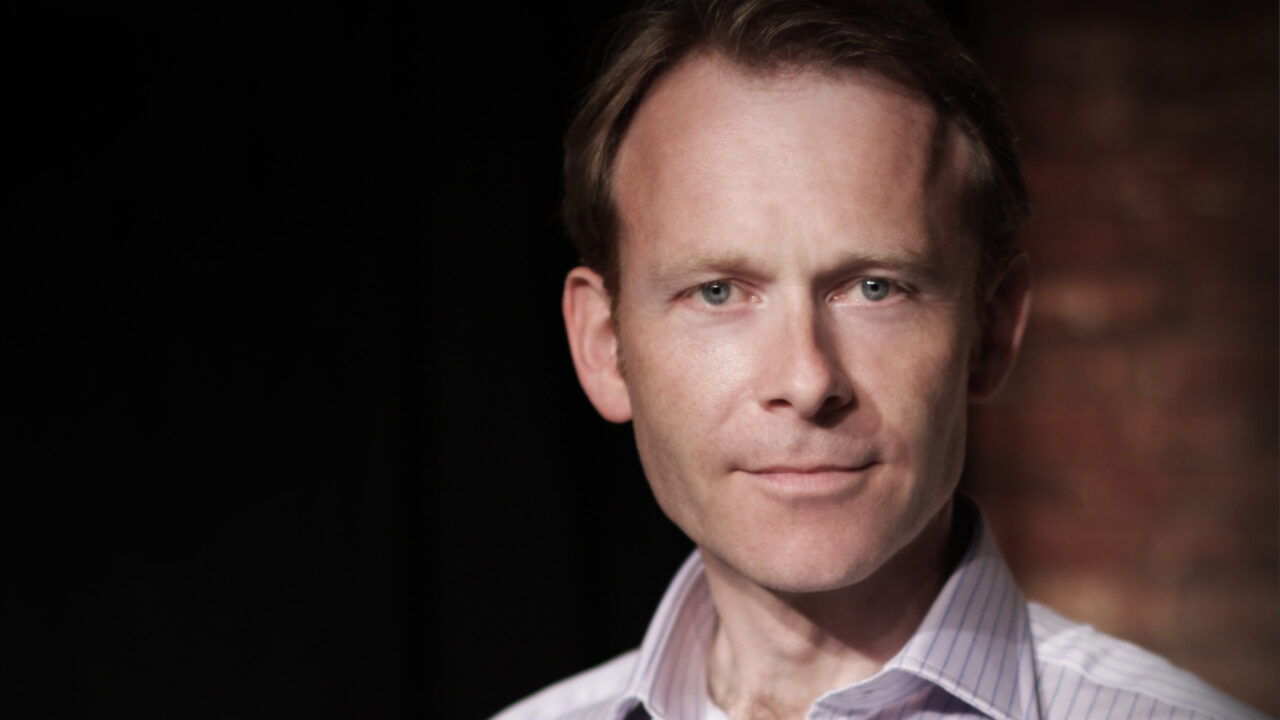
For our first Practitioner Spotlight, we caught up with one of our Leading Edge practitioners, Conrad Hornby.
Conrad told us about his rather unconventional journey from international banking to professional acting: what theatre training taught him about being comfortable with discomfort; and why sometimes simply standing up and saying your name can be a huge act of courage.
For someone who’s never met you, how would you describe yourself – without mentioning your job?
An adapted introvert! I’m somebody who’s quite quiet. I love reading and living in my imagination – getting lost in historical novels for example!
But I also love meeting people. I like to try to make people feel comfortable, I’ll have little conversations with people just to make them feel okay.
I think that’s quite a big part of me – making sure people feel good, feel comfortable.
You’ve had a wonderfully multifaceted career – finance, local government, acting, psychology and even a business selling riding boots. How did that come about?
None of it was planned!
I’m quite able flexing in different situations. I found myself working in the City and it didn’t really feel like the thing I wanted to do. But I had very self-limiting beliefs around, “Why should I become an actor?”
Once I did it, I didn’t turn back. Training as an actor was the best three years of my life. It opened my life up to a whole new set of things I’d been looking for – embodiment, breath, voice – and slowly made me feel more comfortable in moments of feeling uncomfortable.
Performing in front of 800 people would, on paper, scare most people. But I used to really enjoy it. I enjoyed the fear, almost, and that sense of camaraderie.
So although I’m an introvert, I also like being around people. That’s the “adapted” part. I can’t live in my bubble, so I have to come out every now and then! And I find real joy in having lovely conversations with people and finding like-minded people who’ll say, “Yeah, I struggle with this. I struggle with that,” rather than, “I’m rather marvellous.”
It sounds as though your actor training was about much more than learning to perform Shakespeare or sword fight. It changed something about how you were in the world.
I mean, it was those things. I did learn to sword fight! I did learn about Shakespeare.
But I think the biggest thing was that I was just able to be more in my own skin.
Is there a moment in a workshop or coaching session when you think, “Yes, that’s why I do this”?
Yes! And it’s usually not the people who stand up and do a “perfect” presentation.
It’s somebody who stands up there and speaks when, before, they wouldn’t have been able to. They may just say, “Hello, my name is…” and you see them have that little bit of courage.
And that’s usually when their colleagues go quiet and say, “My gosh, I’ve never seen that part of you.”
That’s when I think, this is such a marvellous job.
Is there a relatively small change you see people make that can have a big impact?
For me, it’s about taking space.
Not going through something just to get it over and done with. It’s actually finding some space between thoughts. Then you can think more in the moment; you can string a sentence together.
It’s something I had to learn as well. Even though I trained as an actor, I remember my tutors at drama school saying, “You won’t really start learning until you leave here.” And I think that’s where I did start learning. But by then I had the skills to access in order to do it.
So when people find themselves saying, “This feels really uncomfortable,” and yet they do it anyway – that’s when I get a shiver down my spine.
You’ve worked across so many different industries, cultures and countries. Is there anything you’ve noticed that seems to be true no matter what room you walk into?
I think, when people are really honest, it’s about confidence.
That seems to me to be the universal theme, whether you’re in the legal world, pharmaceuticals, banking or social services.
I love it when people start saying, “Actually, I struggle with a bit of this,” or, “This is something I want to work on,” whereas in the workplace they wouldn’t necessarily say that.
It’s being able to say to yourself, “I don’t know all the answers.” It’s impossible to know all the answers.
What is it about theatre-based workplace training that allows for that, perhaps in a way traditional business training doesn’t?
It’s because you actually do it. You feel the discomfort in the same way that you feel the discomfort when you’re at work.
You replicate that moment in the rehearsal space of a workshop. You feel it, you do it, and you think, “Well, actually, I can overcome that when I’m in the real world.”
And because it’s theatre-based, it’s fun! I think we learn a lot through playing. It’s taking it out of the intellectual and embodying it.
Because you can understand confidence, for example, by reading a book. But that isn’t actually doing it.
Quick Fire
Best piece of advice you’ve ever been given? Trust yourself.
Something cultural you’ve seen, read or heard recently that has stayed with you? Mr Burton.
Something you’re still trying to get better at? The guitar.
What makes you laugh? The ridiculousness of life. Just common things!
And finally, one thing your Leading Edge colleagues don’t know about you? I ordained as a monk last year.