Storytelling in the Classroom
In a school in Stoke, teacher Cathy Shevloff begins her lesson by playing a warm-up game with her Key Stage 4 students. In the round, the group engages in exercises to focus their minds, warm-up their voices, and move around. “It’s the perfect start to the lesson," Cathy told us. “The students enjoy the familiarity of these games to pave the way for the session.”
Cathy is one of a few early adopters of our brand-new Group Storytelling for Performance qualification: trialling the fine points of the syllabus and testing it in her classes. As a long-term teacher of the Group Syllabus suite, she’s well placed to understand what really works with her learners, whilst clearly seeing what’s unique about this new qualification.
“It’s been very fresh, and I’ve felt real freedom,” Cathy told us, having embedded the syllabus into her lessons. “As a teacher, I feel more relaxed and playful in my approach, because everyone’s contribution feels special.”
Group Storytelling for Performance can be likened to Group Recital, as both qualifications place an emphasis on creating and performing as a group. But there’s one major difference. Storytelling still encourages active participation from all learners, but without the requirement for all learners to speak. Instead, Cathy’s classes now weave in mime sequences, movement, music and Makaton signing – a language programme that blends signs, symbols and speech to provide alternative options to communicate. “Each lesson has more variety,” Cathy said. “We get to experiment, play, and I’m less strict!”
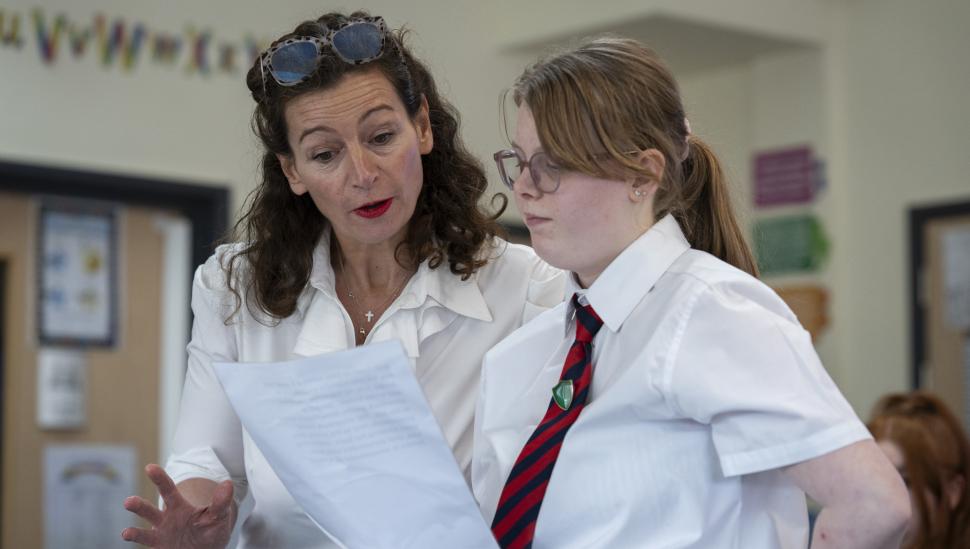
Cathy has been using the Group Storytelling for Performance syllabus for six months now, and she credits the syllabus with a new approach to teaching that has allowed her to bring less confident group members to the surface. “I feel this more alternative style helps me play to the group’s strengths,” she said. “I can tailor the storytelling skills to match the needs in the group – for example, some students have strong reading ability, while others shine when communicating physically.”
“We have eight students all displaying different strengths and personalities,” Cathy continued. “The nature of the syllabus provides everyone with the opportunity to contribute in their own way. For instance, there is one student who is able to express himself far more through movement than words, and so I can cater to his performance style. This student has grown in confidence, as he can see his contribution is valid.”
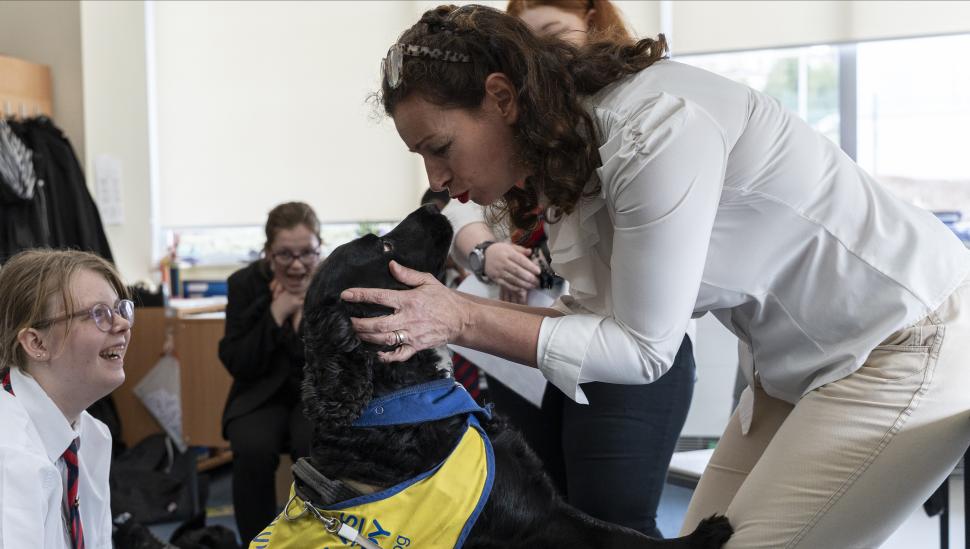
One (perhaps unexpected) member of their group is Barney, the beloved therapy dog who Cathy has integrated into her lessons, and whom her learners love. Above all, Barney’s presence is calming, contributing to the peaceful, supportive atmosphere she wants to foster in her classes.
It’s this that lets her learners feel comfortable and build confidence. “Barney has been known to position himself next to someone who is dysregulated,” Cathy told us. But he even has a starring role in the performance they’re preparing together: “We interact with him, providing water, brush him, and feed him treats, as this features in our piece.”
Stories have always been a big part of her lessons. “I always read the group a story,” she explained. “I’ve discovered a range of books called Little People, Big Dreams, where each book showcases key figures from history. It’s a great way to engage their attention, as well as helping with their comprehension.”
But Cathy thinks that the syllabus is supporting her students’ teamwork and imagination skills, too – in particular, “the ability to work creatively as a team, enjoy storytelling, and think about how stories make audiences feel.” With its embrace of self-expression, a sense of play, and real freedom in lessons, the syllabus feels especially suitable for SEND learners and primary schools.
“We are all storytellers, and we’re using what is right under our nose to creatively tell our story,” Cathy explained. “Everyone is equal, and we are finding our way, without feeling there are right or wrong choices. Each lesson is liberating and free.”
Most of all, the lessons are fun – for Cathy and her students. “We have been on a creative journey together,” she told us. But she is particularly excited for their next exam day, knowing that each learner will come out of the exam having developed their confidence, celebrated their love of storytelling, and felt a huge sense of achievement.
Learn More
The syllabus for Group Storytelling for Performance is now available for teaching ahead of first examinations beginning 1 August 2026. Discover more about the qualification: