Shakespeare in Focus: Stage Combat
Stage combat is a fundamental part of classical actor training. In this Q&A, LAMDA alumnus, tutor and experienced Fight Director Joseph Reed demystifies the art of stage combat, explaining how it strengthens character, intention and storytelling.
Plenty of students won’t have experienced stage combat before they arrive at LAMDA. How would you first introduce it to a new group of students?
No matter what previous experience students may have, we start from the same place. It’s always good to go back to basics. As my martial arts instructor would say, if the first part doesn’t work, nothing does. In our initial sessions, we strip it right back and look at the fundamentals. We consider key safety features, eye contact, distance, how these protect us as actors and how they influence storytelling. The safer and more in control we are as actors, the more expressive our characters are free to be.
Then we examine the core physical principles that run through all combat techniques. Connection to your partner through touch, reading the body, centre line and footwork. What we always come back to is storytelling. We aren’t training stunt people or professional fighters, we are training actors, so story is everything. We ask ourselves, “how can these basic skills contribute to our role as storytellers?”
What should students expect to be involved in during a typical stage combat class?
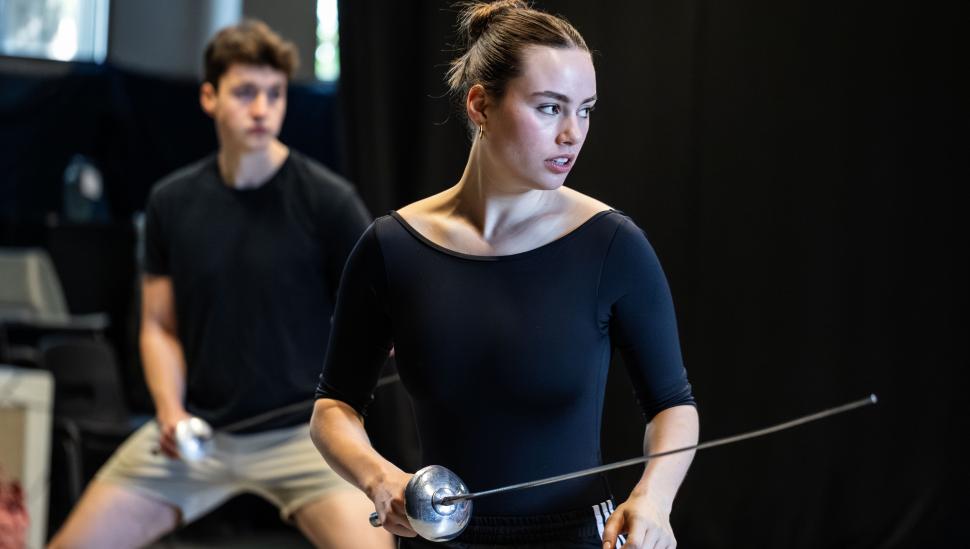
We will work with a variety of weapons and techniques to give students a vocabulary they can take into their professional lives. The goal is to cover enough bases so that whatever is asked of a graduate from lightsabres to halberds, they feel confident to approach the task. Classes are taught through pair-work, sometimes focusing on specific techniques and at other times working with choreography and scenes, but always focusing on the connection with your partner and the relationship you are creating together.
Our philosophy is realism first, so we teach the techniques as they would have been required in reality, whether it’s a modern knife combat or 17th century smallsword duel. However, we ensure that the work is safe. After all, stage combat should be enjoyable!
You trained in Acting at LAMDA before becoming a Fight Director and Choreographer. How did your career begin, and what encouraged you to want to follow a path into stage combat?
I was always interested in combat and have practiced martial arts since I was young. But like most of my students, I didn’t encounter stage combat until I trained at LAMDA. I did the three-year course, and back then we had combat class twice a week, every week for two years, with more in the third year if you wanted it. LAMDA put more students through fight exams at an advanced level than all other drama schools in the UK combined. I ended up doing four years at LAMDA after remitting in my first year, meaning I did a lot of combat and am still the only graduate ever to have taken part in four of LAMDA’s Fight Nights. This meant I graduated with five Level 4 (Advanced Specialisation) qualifications, enough to start shadowing as an instructor.
I am profoundly grateful for the combat training I received at LAMDA. It made me a better actor and provided me with a second career path which has allowed me to continue to express myself creatively, and pay my rent when the acting work wasn’t coming in. It’s been a real blessing, and I enjoy both aspects of my career equally, they both feed into one another. I have had some fantastic opportunities because of combat and am very proud of the lineage passed down to me through John Waller, Rodney Cottier, Jonathan Waller and Kristina Søeborg, and am privileged to be able to pass it on to my students.
Classical actor training at LAMDA encompasses all sorts of classes, from detailed text analysis to voice and movement. How does stage combat integrate into the wider experience of training to be an actor here?
Seamlessly. In essence, combat is a stripped back and physicalised version at the very core of acting. I play an action towards my objective (an attack) my opponent responds with their own reaction. We are both working against a profound obstacle (our character’s lives/safety) and so we have a relationship and therefore a story can develop. The action and the text are inextricable. In fact, combat often possesses the same rhetorical artistry as speech. Particularly classical text. If I attack the same target three times it speaks volumes, just as Shakespeare’s rhetorical power of three, each attack means more than the one before, I insist on the target to get my point across.
There are hundreds more such examples, because like text, combat deals with rhythm and with intention. Whether I am cutting and thrusting with a sword on a battlefield or taking a step towards someone in an office space, every motion is filled with intention towards an objective. This is how we create effective stories, how we move an audience. Combat is a great way to practice everything an actor learns in a text or movement class in a focused and direct manner, they are all parts of the same body.
A unique aspect of our training is the historic Fight Night – a truly celebrated tradition at LAMDA. Can you explain more about what Fight Night is and your own experience taking part?
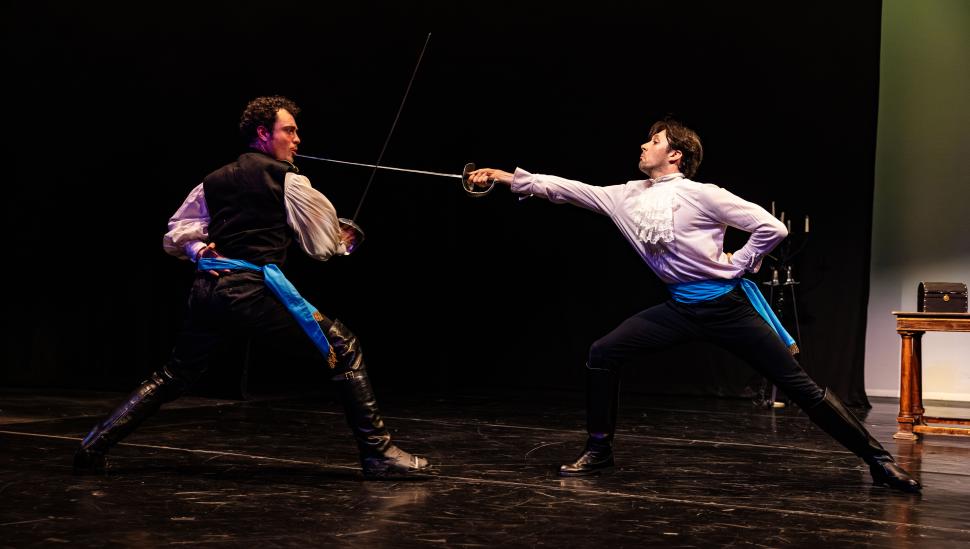
John Waller began Fight Night in 1977. It was set up as a chance for the fighters to have a dress rehearsal prior to their exam the following day. The idea being, if you can perform your fight in front of a full audience of your peers, the exam should be a breeze. The event continued to grow over the next forty-plus years, with John passing on the reins to his son Jonathan when John Senior moved north to become Head of Interpretation at The Royal Armouries. In 1980, Fight Night moved to our MacOwan Theatre, and with it came the person who would choreograph the bulk of the work for the next forty-five years, Rodney Cottier. An acting student on the BA and former competition fencer, Rodney would go on to become Head of the Drama School and my mentor.
Fight Night was a school-wide competition with two trophies up for grabs, Best Fight and Best Technique. Though coveted, the trophies were never taken that seriously; it was all about having fun and demonstrating your skills. The atmosphere on Fight Night was unparalleled, and it was one of the few calendar events that brought the whole school together.
I first took part as a first year in 2012, using a small sword and wielding a 7ft bullwhip. I would compete three more times. It was always utterly terrifying (it never got any easier) but was always incredibly exhilarating. In 2024, after a brief hiatus, Mark [O'Thomas, Principal & CEO at LAMDA] asked us to bring Fight Night back, and after some great work in ‘24 and ’25, our hope is it will continue to grow. Who knows, we may even see those trophies re-emerge. We will see…
Learn More
Apply now to be part of LAMDA’s creative community in 2026, and explore classical actor training at LAMDA in greater depth with our Shakespeare in Focus series: